
The orthostatic test: the key tool to get to know you better and train you better
Your body is talking to you — Are you equipped to hear it?
You slept well, your training schedule says « today »And yet something is wrong. You start, but the legs are heavy, the breathing is forced, and the performance is not on the appointment. This scenario, most athletes lived. And if the real question wasn't « What do I have to do today? » But rather « In what state is my body today? »
This is precisely the question to which the orthostatic test — a scientific tool, simple to perform and remarkably informative, which we use in the center as part of our balance sheets and effort tests.
What is the orthostatic test?
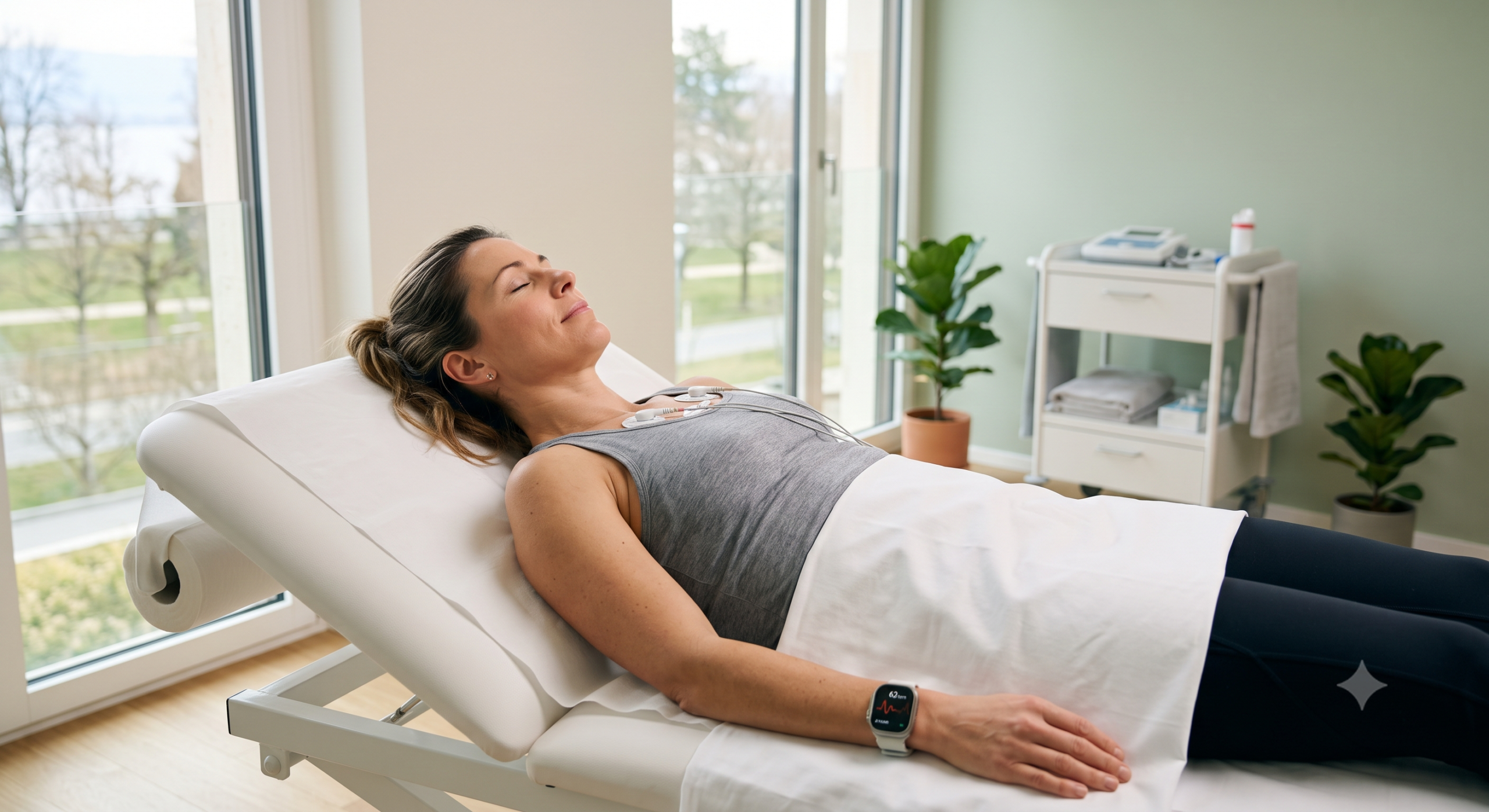
The orthostatic test is a non-invasive examination that analyzes how your body reacts to the simple change of position: moving from the elongated position to the standing position. This transition, as common as it seems, triggers a cascade of highly revealing physiological responses to the state of your autonomous nervous system (NAS).
In practice, the test is conducted in two phases:
– 15 minutes lying Your body is in complete rest. We see here the parasympathic dominance, that is, the ability of your body to recover, regenerate, and « blow ».
– 5 minutes standing When you get up (2 to 3 seconds), the body must adapt quickly. We then analyze the sympathetic reactivity and the speed at which you find a balance.
What is measured throughout the test is the heart rate variability (HRV) — or small variations in duration between two successive heartbeats. These microvariations are not « noise » : they are the signature of the activity of your autonomous nervous system.
The autonomous nervous system: the invisible conductor
To understand why this test is so valuable, one must understand the role of the autonomous nervous system. It constantly regulates vital functions without you having to think about it: heart rate, blood pressure, digestion, recovery. It consists of two complementary branches:
– The parasympathic system : the mode « rest and regeneration ». It slows down the heart, promotes recovery, stimulates cellular repair processes.
– The sympathetic system : the mode « Action and adaptation ». It accelerates the heart, mobilizes energy, prepares the body for stress or stress.
A healthy organism moves smoothly and quickly from one mode to another. A body under chronic pressure (fatigue, overwork, stress, emerging illness) loses flexibility: the sympathetic remains dominant, even at rest, and the parasympathic struggles to express.
It is precisely this autonomous flexibility that the orthostatic test evaluates, by offering a faithful photograph of the state of your nervous system at instant T.
What we read in the figures
The data produced by the test are not abstract. They are based on scientifically validated indicators:
RMSSD — the reflection of your recovery
RMSSD is the most reliable indicator of parasympathic activity. It measures the variations between successive beats: the higher it is, the more active and efficient your recovery system.
SDNN — overall variability
The NSDS reflects overall variability in heart rate, integrating both sympathetic and parasympathetic activity. An SDNN greater than 100 ms is excellent; below 50 ms, significant imbalances may be present.
LF/HF — the power ratio between the two systems
This ratio measures the balance between sympathetic (LF) and parasympathic (HF). At long rest, a ratio between 0.5 and 1.5 shows a healthy balance. A ratio greater than 2.5 indicates a sympathetic dominance — potential sign of chronic stress, fatigue or insufficient recovery.
Why two phases (longed and then standing)?
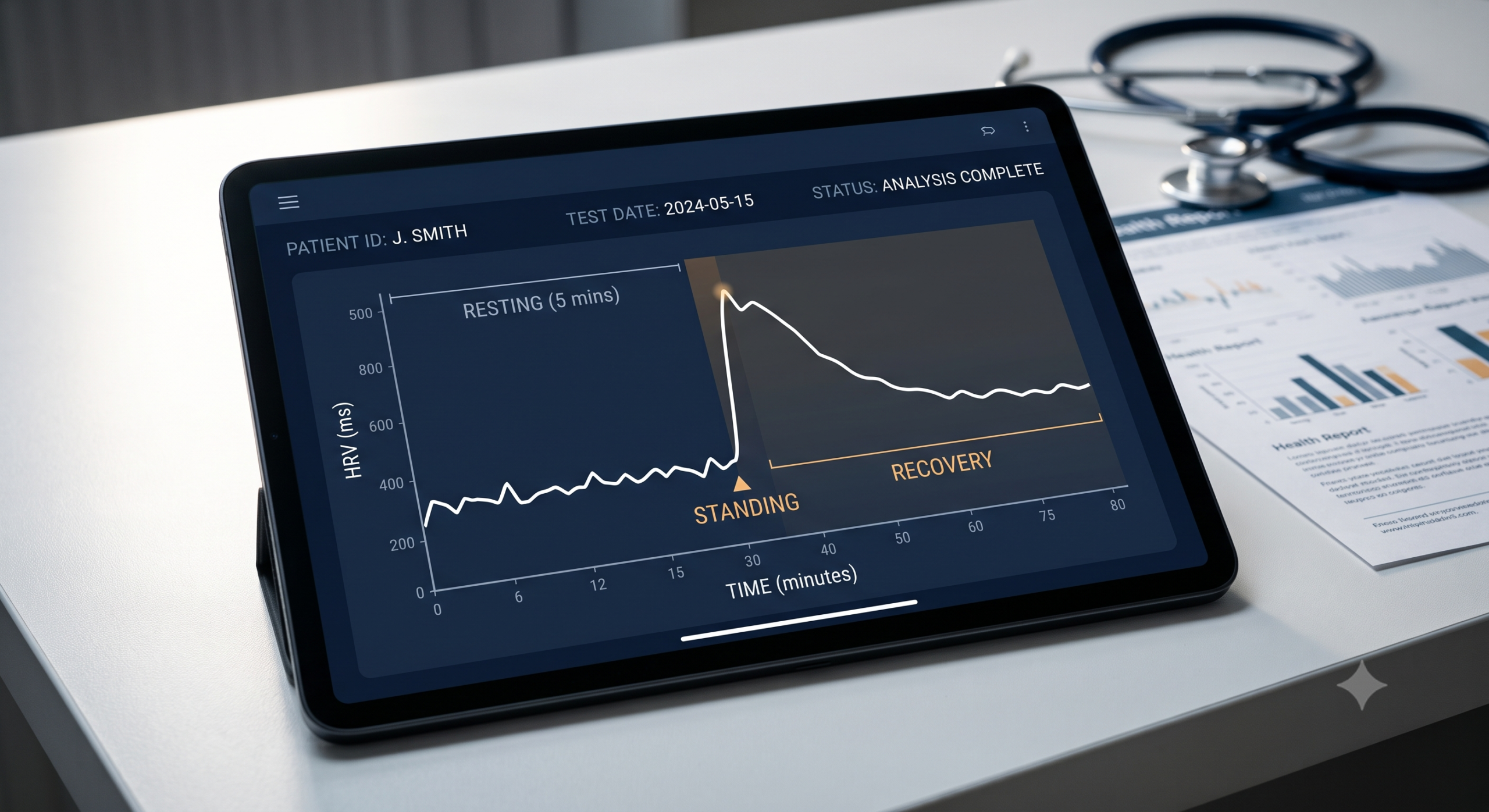
The originality of the orthostatic test lies in this double reading:
1. Long phase reveals your basic recovery level. It's your « Parasympathic capital ». A high resting vagal tone is associated with better coping with stress, better post-effort recovery, and more robust cardiovascular health.
2. The Standing Phase test your self-reactivity. When you get up, a slight drop in blood pressure triggers a reflex: the sympathetic system active to compensate (heart acceleration, vasoconstriction). Then, in the following minutes, the parasympathic gradually regains its upper hand. This return to equilibrium curve is analyzed minute by minute — sometimes called autonomous homeostasis.
A quick and harmonious return to balance is a sign of good health and adaptability. A slow or chaotic return may indicate a system that has been exhausted or is under too high a load.
How do we use this test in the center?
In the centre, the orthostatic test is part of a global approach inspired by the Salutogenicity — a philosophy that focuses on understanding and strengthening health resources, rather than just correcting pathologies.
We do not use orthostatic testing as an isolated tool. It is part of a comprehensive protocol that also includes a progressive increment stress test on treadmills. This combination allows us to draw up two complementary tables:
– The table of rest : state of the autonomic nervous system, recovery level, sympatho-vagal balance.
– The table of effort : ventilator thresholds, heart response to increasing intensity, individualized training areas.
By crossing these two readings, we can accurately answer fundamental questions: At what intensity do I have to train to progress without degrading myself? Is my nervous system capable of bearing the expected training load? Am I getting enough?
The orthostatic test, for whom?
Contrary to what one might think, this tool is not only for high-performance athletes. It is relevant for anyone who wants to better understand their body and make training or recovery decisions based on objective data:
– Regular athletes who want to optimize their training, avoid overwork and better period their efforts.
– Active persons who seek to balance sport, work and personal life, often under chronic pressure difficult to quantify.
– People in reconditioning or prevention who resume physical activity after a period of sedentaryness, illness, or prolonged fatigue.
– Everyone wishing to integrate a proactive approach to health monitoring into a sustainable well-being approach.
What the test does not replace
Orthostatic testing is a valuable indicator, but it remains one of many tools. It does not replace a medical check-up, subjective listening to its sensations, or monitoring the quality of sleep or nutrition. It is all the more useful that the measurements are repeated in time and under stable conditions (ideally in the morning, fasting, in the calm).
That is precisely why we are integrating this test into a comprehensive assessment protocol, not as a one-off measure. The objective is to build with each person a personal baseline — an individual reference — from which the variations become significant and actionable.

In short: what the orthostatic test teaches us
One test, two positions, dozens of information about your real health.
In less than 20 minutes, the orthostatic test allows:
– Evaluate the activity of your autonomous nervous system at rest and in reaction
– Identify sympathetic dominance (chronic stress, overwork, fatigue)
– Estimate your actual recovery capacity
– Detect early warning signals before they become symptoms
– Individualize your training or fitness program
It is this combination of simplicity of achievement and wealth of information that makes it one of the most relevant tools in a modern, personalized and long-term health-oriented approach.
__________________________
Would you like to take an orthostatic test and discover what your autonomous nervous system says about your state of shape? Contact us to organize a comprehensive assessment, tailored to your profile and objectives.
@Lonhea – Patented Method

