
Heart rate variability (HRV): understand what your heart says about your stress... and your recovery
Heart rate variability (HRV) corresponds to the small time variations between two successive heart beats, and reflects the activity of your autonomous nervous system. Tracked correctly, it becomes a simple benchmark to better understand your level of recovery, stress load and how your body adapts to everyday life.
HRV: What exactly are we talking about?
Contrary to a common idea, your heart does not beat like a metronome: the interval between two beats constantly changes, and it is precisely this variation that is called HRV. This variability comes from a dynamic balance between two "modes" of your autonomous nervous system: parasympathetic (recovery, regeneration) and sympathetic (adaptation, stress response).
A very eloquent phenomenon illustrates this mechanism: when you inspire, the heart rate accelerates slightly, and when you exhale it slows down (it is respiratory sinus rhythmia). This back and forth is strongly related to parasympathic activity, often associated with improved recovery capacity.
What "means" a high or low HRV
A higher HRV is usually the sign of a more flexible autonomous system, able to adapt and return to equilibrium. Conversely, a decreasing HRV can translate fatigue of the system (stress, drive load, inflammation...), especially if the decrease is clear compared to your usual values.
The key point to remember: we interpret the HRV better by following its trends (your personal "baseline") rather than comparing an isolated value to someone else. In practice, a variation greater than 20% from your reference level is considered significant and deserves to be taken seriously.
Simple indicators to know (without jargon)
There are many HRV parameters, but you don't need to master them all to get something useful. These are the most common, explained simply.
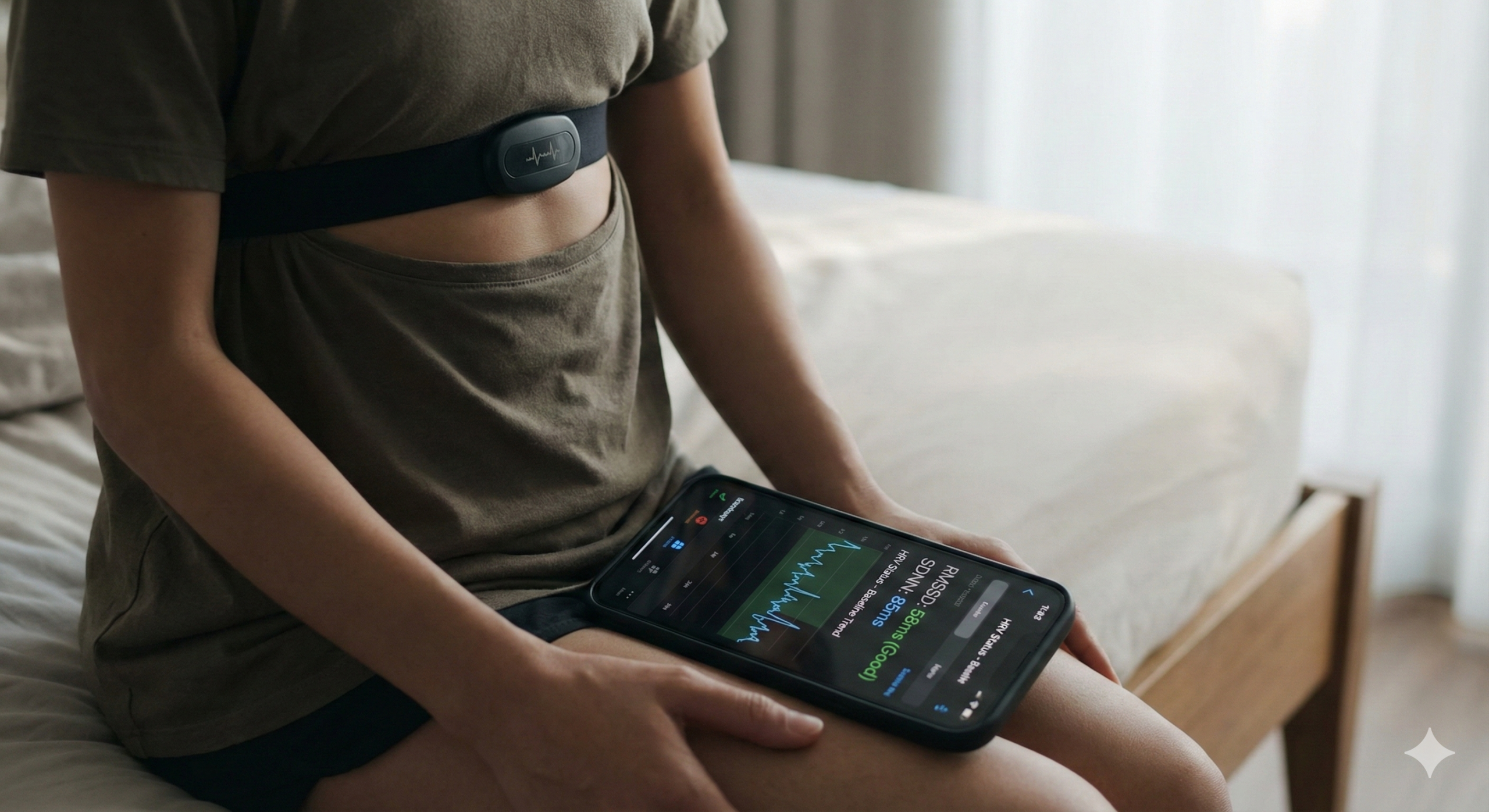
- RMSSD : c’est l’indicateur le plus fiable de l’activité parasympathique (donc souvent, de la récupération). Repères proposés : >65 ms = excellent, 35–65 ms = bien, 20–35 ms = moyen, <20 ms = critique.
- SDNN : reflète la variabilité globale (parasympathique + sympathique). Repères proposés : >100 ms = excellent, 50–100 ms = acceptable, <50 ms = critique.
- LF/HF (ratio) : donne une lecture de l’équilibre “sympathique vs parasympathique” (à interpréter avec précaution, mais utile en profilage). Repères proposés au repos : 0.5–1.5 = équilibré, >2.5 = dominance sympathique, <0.5 = dominance parasympathique.
Keep in mind: "normal" values vary according to age, sex and level of training. For example, RMSSD gradually declines with age, and women have on average 10–15% lower RMSSD values than men.
How to measure your HRV correctly (and make it a concrete tool)
For a "health/performance" measure, the simplest approach is regular monitoring with a short protocol. The aim is to compare measurements made under stable conditions, in order to detect real changes rather than "noise".
Good operational practices:
- Measure with a short protocol of 5 to 15 minutes, ideally in the morning, in a sitting or elongated position, in a standardized way.
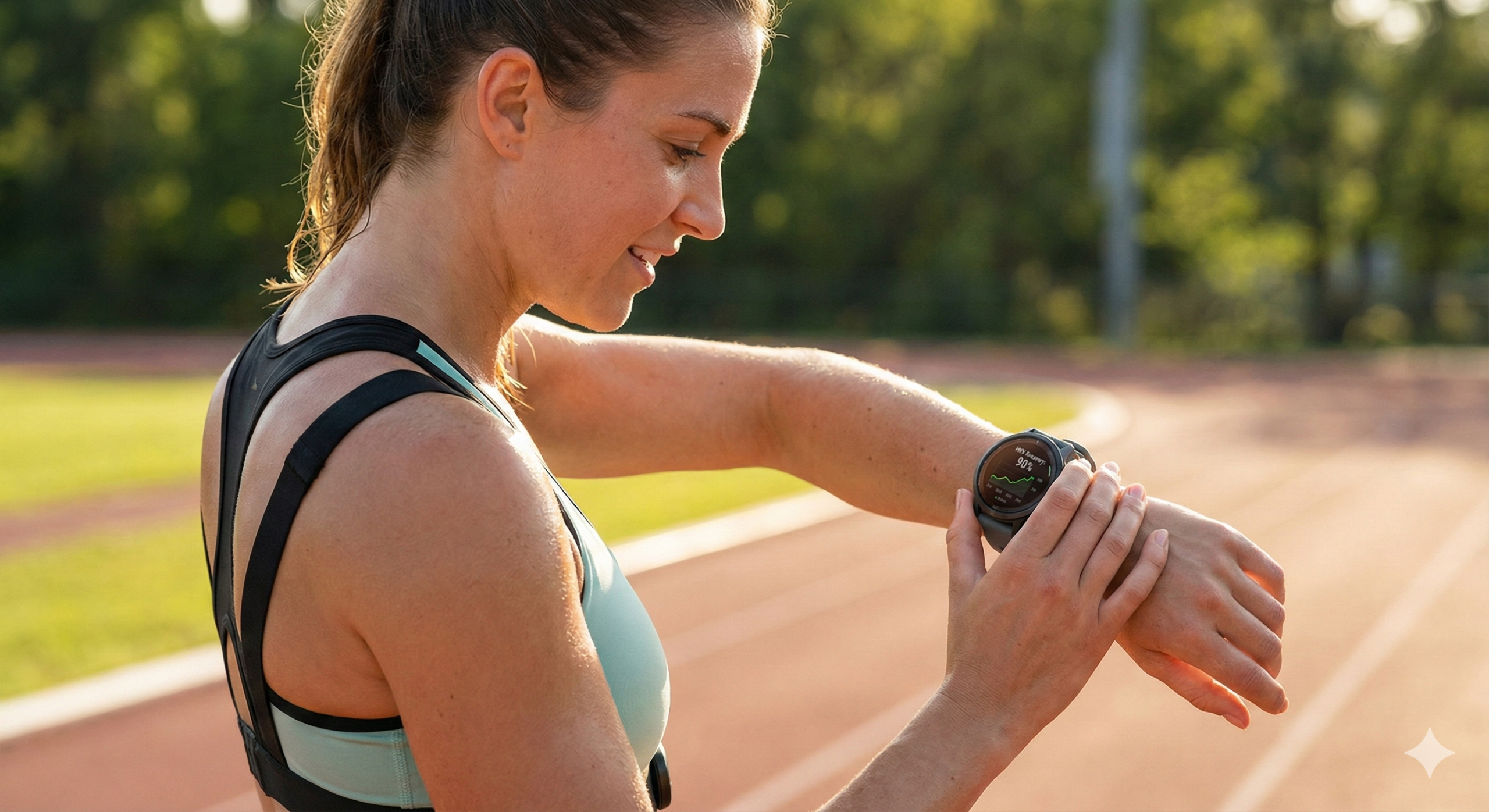
- Prioritise a chest belt (recommended), as connected watches have precision limits and analysis depends heavily on signal quality.
- Above all, use trends: if your HRV drops by more than 20% vs. your baseline, this can justify a lighter day ("unload") or more recovery.
- Further "balancing" option: an orthostatic test (15 minutes elongated + 5 minutes standing) evaluates the parasympathic dominance at rest and then the sympathetic reactivity to rise.
Concrete example (simple reading): if your RMSSD is usually stable and falls sharply (beyond the threshold of significant variation), it is a signal that your system is more "stressed" than usual; The idea is then to adjust sleep, recovery, intensity training and stress management before stacking the load.
What HRV can help identify (without replacing a medical opinion)
The HRV is used as an indirect marker of the state of the autonomous system and can contribute to early detection of imbalances. It is described in particular as sensitive to contexts associated with oxidative stress, inflammation and alterations of mitochondrial function (cell energy), via specific index profiles.
It can also be used to detect early warning signals, such as a net drop in NSDS (beyond 20% of baseline), a very low MSSD, and a marked rise in resting heart rate, which may occur 24–48 hours before symptoms. Finally, some HRV thresholds are presented as useful in the evaluation of cardiovascular risk (e.g. critical thresholds for NSDS) and in more specialized follow-up.
How to apply it to the centre: orthostatic testing & health checks
In the centre, the HRV is not only an "interesting measure": it is used with standardized protocols to obtain a reliable photo of your nervous balance (stress/recovery) and to monitor its evolution over time. The idea is simple: measure in good conditions, interpret with several indicators, then translate this into concrete and personalized actions.
The orthostatic test
Le test orthostatique est un test structuré en deux phases : 15 minutes en position allongée, puis un passage debout rapide (2–3 secondes) avec 5 minutes d’analyse. La phase allongée sert à observer la dominance parasympathique attendue au repos, avec des repères comme RMSSD >50 ms (excellent), HF >1500 ms² (excellent) et LF/HF <1 (optimal). La phase debout provoque une réponse sympathique normale (“coup d’accélérateur”) et on analyse minute par minute la réactivité et le retour vers l’équilibre (T1 pic sympathique, T2–T3 stabilisation, T4–T5 retour à l’homéostasie).
The point is to see both your "level of recovery" at rest and your ability to adapt to changing posture, which makes the test very meaningful in real life.
We integrate this test into our balance sheets and evaluations at the centre, especially in our effort tests, in order to link this information to field measurements and make it a truly actionable tool. In concrete terms, it can be part of both a performance approach (sports programmes, adaptation of the load and recovery) and a health prevention and monitoring approach, with personalized support and monitoring over time.
__________________________
@Lonhea – Patented Method

