
Neurocom test: why use it to evaluate balance?
Losing balance, feeling less stable, hesitating on support or lacking confidence in certain movements is not always linked to a simple lack of strength. Very often, it also concerns how the brain uses information from the eyes, feet, muscles, joints and inner ear to keep the body stable.
It is precisely to better understand these mechanisms that Athletica uses the Neurocom test. This evaluation makes it possible to analyse in a fine way the different systems involved in balance, in order to better target the work to be put in place afterwards.
What is the Neurocom test?
The Neurocom test is a comprehensive assessment of sensori-motor integration. Clearly, it helps to understand how a person uses sensory information to maintain balance, control posture and move securely.
Its interest is not to limit itself to an overall observation of the "balance is good" or "balance is fragile". On the contrary, it makes it possible to identify more precisely which system seems to be in most difficulty: vision, proprioception, vestibular system, postural control, coordination or certain functional abilities such as rising from a chair or crossing an obstacle.
Why does Athletica use it?
At Athletica, the Neurocom test allows you to go beyond the feeling and objectify what actually happens in the balance control. The aim is not only to see an embarrassment, but to understand where it comes from in order to offer more precise accompaniment.
This approach is particularly useful, since the analysis of indicators enables the identification of the most fragile sensory systems and directs targeted and personalized support. The principle is simple: evaluate, prioritize, choose the right exercises, and then re-evaluate to adjust the program according to evolution.
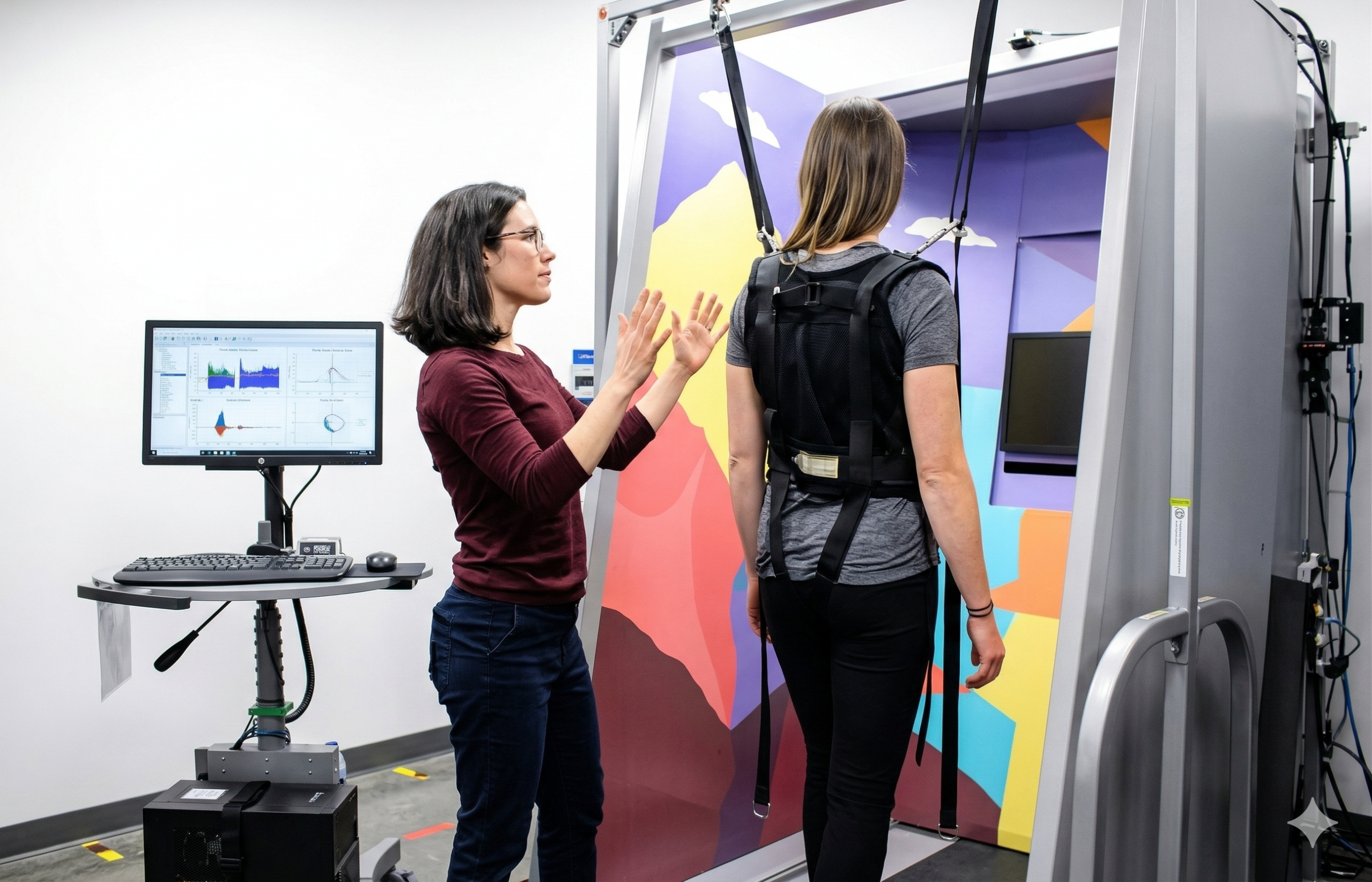
What the test analyzes
-The Neurocom does not look at one aspect of balance. He explores several complementary dimensions that allow a much more complete vision of postural functioning.
Among the elements analysed are:
- The ability to remain stable under different sensory conditions.
- The way the body uses vision, supports and vestibular system.
- Centre of gravity alignment and static postural control.
- The ability to move weight in several directions without losing control.
- Reaction speed, motion accuracy and confidence in balance.
- Functional gestures of everyday life such as sitting-standing, slitting or crossing obstacles.
- Coordination between eyes, head and cervical region.
The mCTSIB test: understanding what the body relies on
One of the major components of Neurocom is mCTSIB, a test that assesses the ability of the nervous system to integrate different sensory information to maintain balance in several situations.
This test compares four conditions:
- Stable ground, open eyes: reference situation, with all available systems.
- Stable ground, closed eyes: vision can no longer help, the body must rely more on support and proprioception.
- Flexible surface, open eyes: supports are disturbed, vision helps to compensate more.
- Flexible surface, closed eyes: this situation almost exclusively isolates the vestibular system and is a priority indicator of its function.
This makes this test particularly interesting. It allows us to see whether a person is too dependent on the view, whether he or she is using his or her supports poorly, or whether his or her vestibular system seems to be less effective, especially under the most demanding conditions.
Why the vestibular system is so important
The vestibular system is located in the inner ear. It detects head movements, accelerations and the position of the body relative to gravity.
When the "soft surface, closed eyes" condition is difficult, this may reveal a significant vestibular deficit. This represents a major risk factor for falling, especially in the dark or unstable terrain.
Centre of gravity and limits of stability
The Neurocom also analyses the alignment of the centre of gravity. This indicator provides information on static postural control, body position awareness and ability to maintain an effective vertical posture.
Good alignment helps to reduce energy expenditure and reduce some musculoskeletal pain, while a bad alignment may increase the risk of imbalance, especially backwards.
The stability limit test measures the ability to voluntarily move its centre of gravity in eight directions. It assesses both dynamic postural control and confidence in balance.
Speed, accuracy and confidence
The balance is not just about "holding up". It is also necessary to be able to react quickly, to steer his movement in the right direction and to dare mobilize his body without being unduly restrained.
The Neurocom thus measures the reaction time, speed of movement, directional control, as well as the distance reached from the first attempt and the maximum distance actually reached. Together, these data help to better understand whether the difficulty lies in a lack of coordination, weakness, apprehension or misperception of its own limitations.
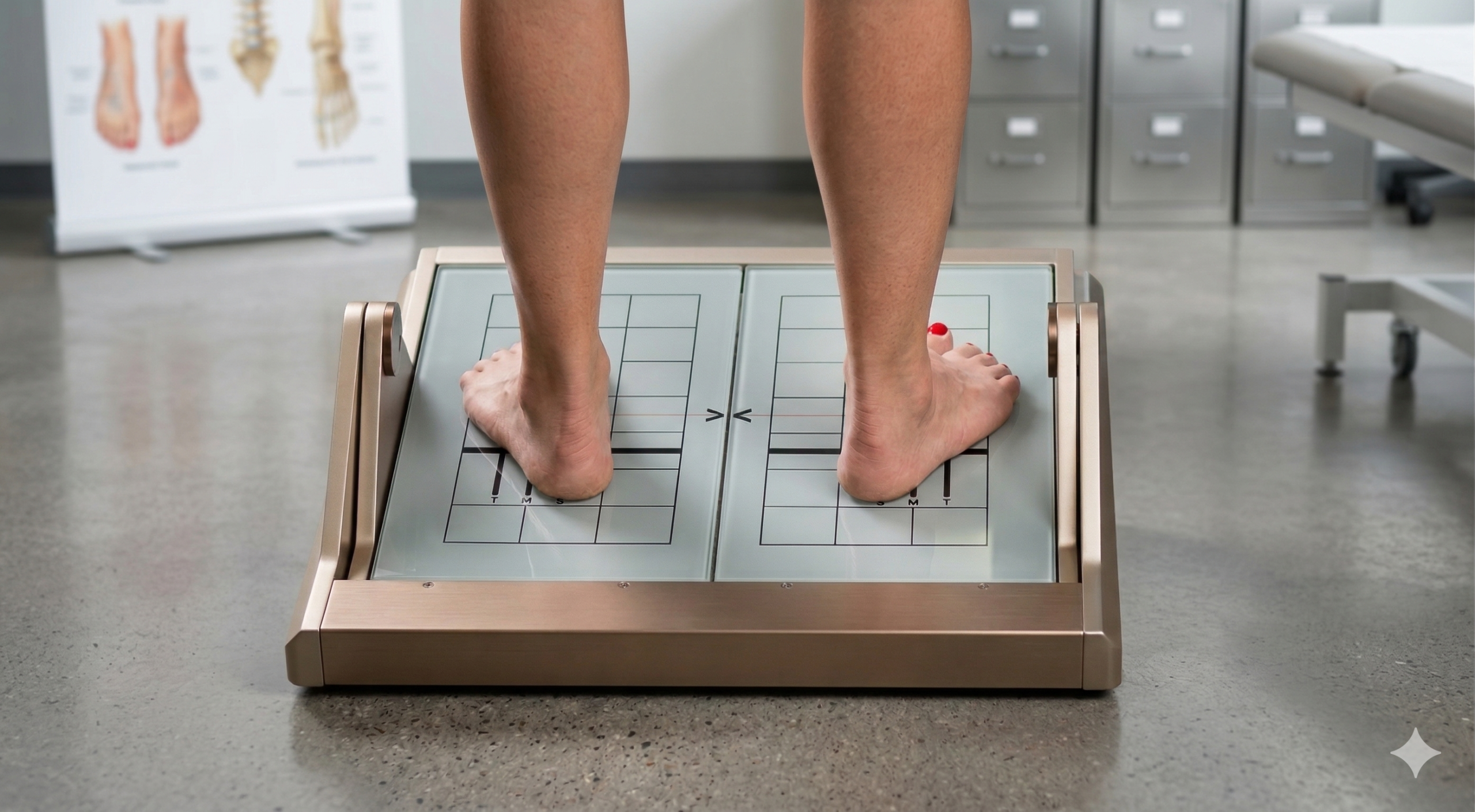
Useful tests in everyday life
The interest of Neurocom is also to link evaluation with concrete actions. The sitting-up test, for example, provides information on hip and knee strength, neuromuscular coordination, symmetry of supports, and the ability to achieve an essential postural transition in everyday life.
Other elements such as front slots, obstacle crossing, lumbar stability or cervical functions provide additional information on mobility, motor control and safety in everyday movements.
A tool to customize exercises
One of the main interests of Neurocom is to allow targeted work. The analysis of results is used to identify rehabilitation priorities, including vestibular, force, proprioception, coordination or mobility.
In concrete terms, this means that two people with balance disorders will not necessarily receive the same program. If the weak point mainly concerns the vestibular, the work will be able to focus on the movements of the head, the stabilization of the look and the balance of eyes closed; If the difficulty affects strength and functional control more, the program will be able to focus on sitting, squats, step-ups or progressive slots.
Why this approach makes sense at Athletica
Using the Neurocom test at Athletica means giving more precision to the evaluation and more consistency to the accompaniment. Instead of offering generic exercises, it becomes possible to use concrete indicators to build a progression adapted to the person's profile, abilities and objectives.
This logic is based on several essential principles: the specificity of the work, the gradual progression, the functionality of the exercises, the sensory feedback and the ability to adapt the nervous system. In other words, we are not just trying to "drink more", but to make the right systems work, at the right level, in the right order.
Who can benefit from this type of evaluation?
Such an assessment can make sense for people who feel less stable, are afraid of falling, lack confidence in their support, or want to better understand the origin of an imbalance. It can also be relevant when certain everyday gestures, such as getting up, walking on an irregular terrain or turning head in motion, become less comfortable.
The point is not to stick a label, but to better direct the work. The more difficulties are identified, the more useful and progressive the exercises can be adapted.
To be retained
The Neurocom test is used at Athletica to analyse in depth the mechanisms of equilibrium. It allows us to identify which systems are most fragile, to better understand the difficulties observed and to build a personalized support, with exercises targeted to the real needs of each person.
__________________________
@Lonhea – Patented Method

