
Curvatures after sport: what your body is really trying to tell you
You got up this morning with your thighs on fire after your session last night? You're having trouble getting down the stairs the day after a practice? You're not alone. These well-known muscle pains — called DOMS* in English (*Delayed Onset Muscle Soreness, either « delayed onset muscle pain ») — concerningabsolutely all athletes, beginners as confirmed.
But here's what most people don't know:Curvatures don't come from where you believe.And understanding them is learning to listen better to your body to progress more intelligently.
Curvatures: What exactly is it?
Curvatures are these muscle pains and stiffnesses that occura few hours to a few days after intense or unusual exercise.They're not immediate. — This is precisely what makes them so characteristic.
Here are their typical chronology:
– 6-12 hours after exercise: the first pains appear
– 24 to 72 hours later: it is the peak of pain (often the famous « race day » or « next day »)
– 5-7 days later: complete disappearance, without any sequence
In concrete terms, you experience pain in pressure and movement, stiffness, a temporary decrease in strength and sometimes a slight swelling. Exercises where your muscles « brake » — down stairs, squatting down slowly, running downhill — are the main culprits, because this type of contraction (so calledeccentric) subject your muscles and tissues to much higher mechanical forces than others.

The lactic acid theory? She's been refuted for a long time.
For years, curvature has been attributed to accumulation of lactic acid in muscles.This idea is now completely outdated.
Why? Because lactic acid is completely eliminated by the body inless than one hourafter effort. However, your sternness reaches its maximum 24 to 72 hours later. The timing doesn't match at all.
Another long-advanced theory: free radicals ( molecules produced during effort). Except that their blood elevation is observed 24 to 48 hoursafterthe DOMS peak, not before. And antioxidants have almost no effect on pain. So, if you're snacking on blueberries hoping to avoid the bends... It's too late, and that's not where it happens.
So, where does the curvature really come from?
Science has made great progress in recent years. Three major players are now identified.
1. Your fascia suffers more than your muscle
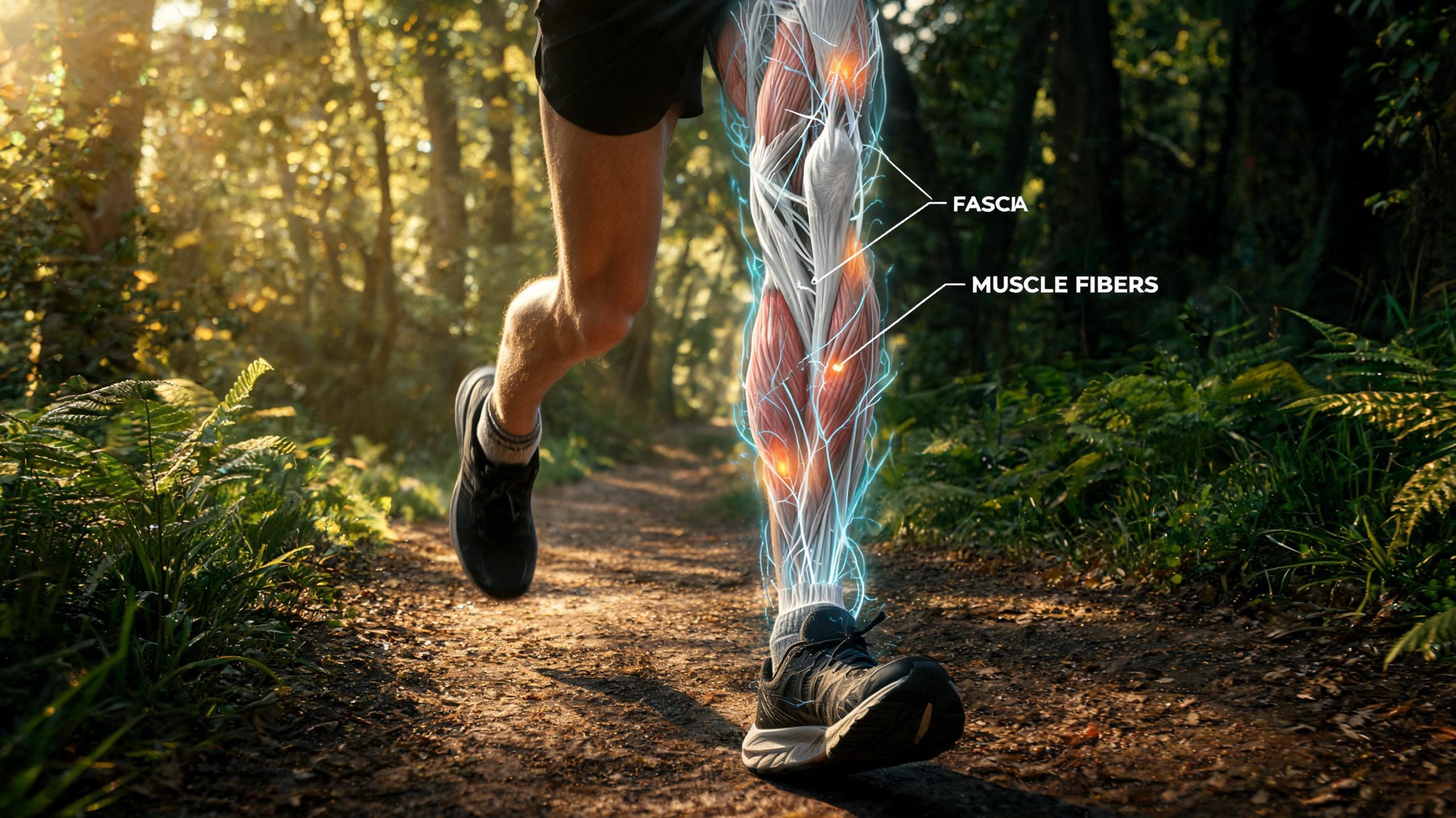
Thefasciais this bundle of connective tissue that surrounds, separates and connects all your muscles, bones and nerves. Imagine an ultra-precise inner combination that keeps everything in place.
What we didn't know until recently:fascia is one of the richest innervated tissues of your body. It containsSix times more motion sensors and pain sensors than muscle tissue itself, and the density of nerve fibres is three times higher than that of the muscle.
A particularly revealing study compared two identical injections (a slightly irritating saline solution): one in the deep fascia, the other in the muscle. Result? Injection into the fascia caused pain39% more intenseOnly the one in the muscle. Even better: during a DOMS, it is the fascia — not the muscle — which became hypersensitive.
After an intense eccentric effort, we also observe:
– Thickening of the fascia, correlated with the intensity of the pain felt
– A degradation of collagen that composes this tissue (measuring up to 72 hours after exercise)
– An accumulation of hyaluronic acid that alters the slip between the layers of the fascia — and it is this rigidity that generates the feeling of stiffness
2. Curvature starts during the effort, not after
A major scientific breakthrough: sternness is not born hours after your training.The process starts during the exercise itself.
Researchers have found that the first lesion affectsproprioceptive nerve endings(those who constantly inform you about the position of your limbs and your movements) located in the muscle zones. This initial disturbance, imperceptible, then opens the way to a cascade of reactions — inflammation, activation of pain fibers — which leads to classical curvature.
This explains why you can have severe back pain without any visible muscle damage being detectable by imaging.
3. Your brain handles the pain
The third actor, not least, is your brain. Professor Tim Noakes, a world-renowned South African researcher, proposed decades ago a theory that revolutionized our understanding of fatigue:the central governor.
The idea is simple but deep: your brain constantly monitors dozens of parameters — temperature, heart rate, energy reserves, pain, metabolic status — and regulates your performancebeforethat your body reaches its real limits. It is he who triggers the feeling of fatigue as an early alarm signal, to protect you.
In this context, the pain of curvature is not a simple « mechanical damage ». It's aactive message from your central nervous systemwhich aims to:
– Protecting fragile tissue from additional overload
– Force you to rest to allow repair
– Reprogram your movements to avoid painful gestures
– Prepare your body to better withstand the same stress in the future
In other words, if you have any bends, your brain has decided to lift your foot for you. This is a sign that your body adapts and strengthens.
HRV: Your body warns you before you even get hurt
TheHRV* (Heart Rate Variability*, or heart rate variability) is the variation of time between each heartbeat. This parameter, measurable with some connected watches or applications, reflects the state of your autonomous nervous system — this autopilot that manages your recovery, digestion, stress.
A high HRV = your body recovers well. A low HRV = your body is still under pressure.
What is fascinating:HRV changes during the exercise that will cause curvature, long before pain appears. A recent study of elite handballers showed that the HRV profiles of athletes who were going to develop important DMS were significantly different from the warm-up phase — hours before any pain.
Researchers have even identified acritical threshold around 120 beats per minuteIn addition, physiological stress would shift from an area of positive adaptation to an area of risk of injury. To detect this threshold in real time would make it possible to adapt the exercise (e.g. to movements without braking phase) before the damage accumulates.
After the effort, the HRV also tells you the quality of your recovery:
– HRV standardized in less than 24 hours: your body has recovered well, you can maintain your program
– HRV still low after 24-48h + curvature: the load was too high, the intensity must be reduced
– HRV bass without bends: attention, an external factor disrupts your recovery (lack of sleep, mental stress, overwork)
Good news: Curvatures make you stronger
Perhaps the best news of this article is: if you repeat the same exercise that caused you to be sore,pain will be much less intense the second time. This phenomenon is calledprotective effect of repetition*(*Repeated Bout Effect*).
Your fascia and your nerve endings adapt, become more resistant, and your brain records the movement as « already seen, no danger ». This is proof that the sterns are not a problem to remove, buta signal that your body is progressing.
5 concrete strategies to better recover
Now that you understand why sternness appears, here's how to work intelligently with your body:
Before the effort: preparing the fascia
– Climb the load graduallyYour fascia needs time to adapt, just like your muscles. Never double the volume once.
– Variate movement: dynamic stretching, multi-directional exercises and light plyometry lead your fascia to tolerate different types of stresses.
During the effort: pay attention to the signals
– If you wear a watch measuring the HRV, look at it. A sharp drop may indicate that you are exceeding your adaptation area.
– Slow down or remove braking phases if you feel alarm signals.
After the effort: target fascia
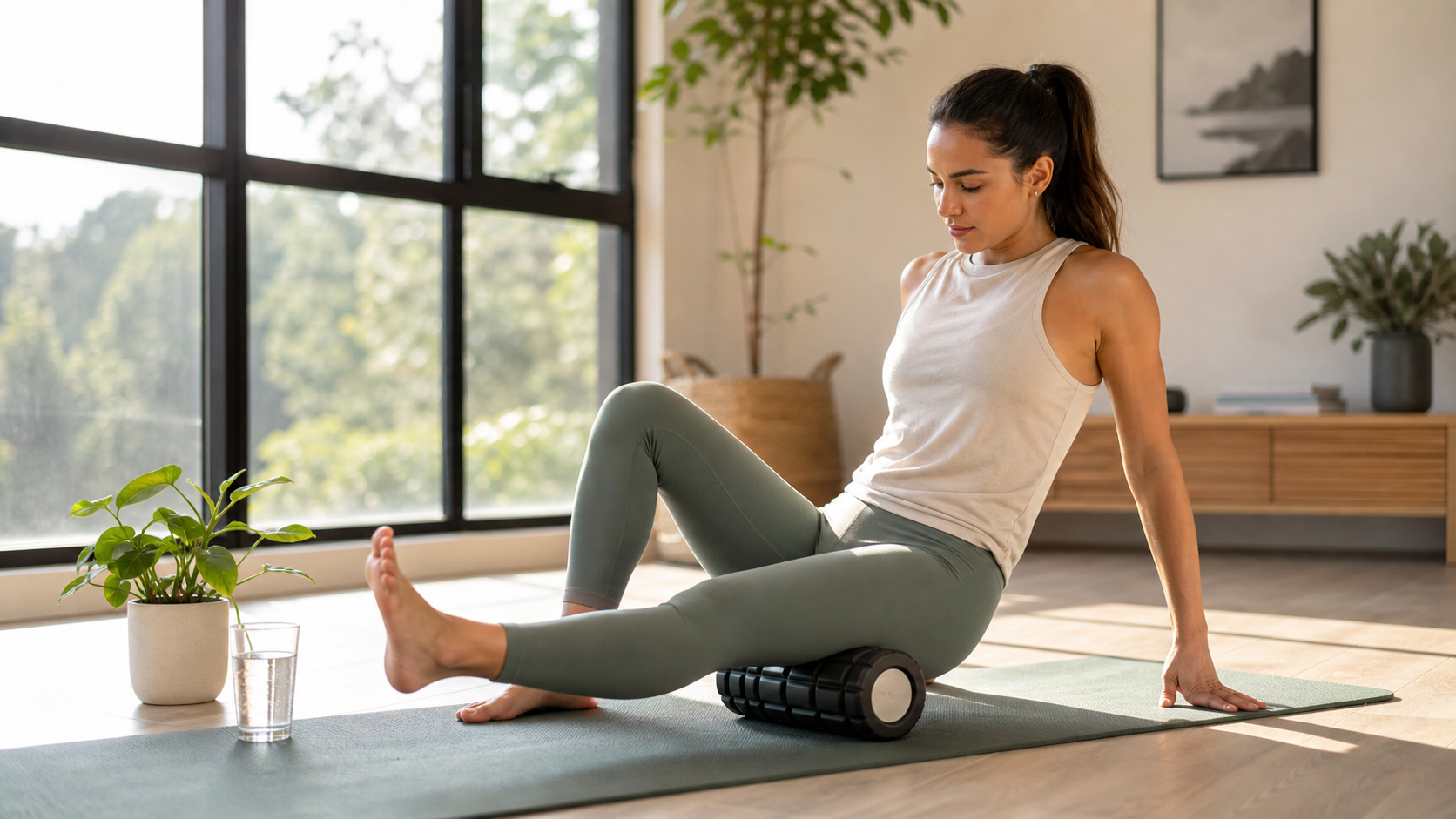
– Foam rolling (massage roll): riding on your muscles does not only work on the muscle — it improves slipping between layers of fascia, reduces painful sensitivity and restores your mobility. This is one of the best validated methods.
– Cryotherapy and compression(cold baths, compression sleeves): promising results to reduce fascia inflammation and accelerate recovery.
– Collagen peptidescontrolled trials have shown a significant reduction in soreness and faster recovery of muscle strength in athletes who consume them after exercise.
Active rest
Slowly move (walking, swimming lightly, cycling without resistance) keeps the blood circulation without asking for painful areas. Your fascia recovers better in motion than immobilized.
What the sterns teach you about yourself
Curvature is much more than just pain. They are the signature of a dialogue between your fascia, your nervous system and your brain. Far from being an enemy to fight, they are aprecious biological signal: your body has been stimulated enough to trigger a process of remodeling and adaptation.
Understanding this message is learning to measure your effort with intelligence, to recover with method, and to progress sustainably — without ever going beyond what your body can actually cash.
Next time you struggle to get down a staircase after a good session, think about it:your body is rebuilding better.
Do you have questions about recovery or how to optimize your workouts? Don't hesitate to visit us — Our team is here to support you in your progress.
__________________________
@Lonhea – Patented Method

