
Liver fat (Hepatic Steatosis): understand all about this silent liver disease
What is liver steatosis?
Liver steatosis refers to excessive accumulation of fat inside the liver. The generic scientific term is SLD (English steatotic driver disease, or « Stearotic liver disease »), which groups several different situations according to the main cause of this accumulation of fat.
To find yourself there, you need to know some abbreviations that often come back:
* MASLD - metabolically dominant steatosis, i.e. related to the functioning of the body (weight, sugar, cholesterol). It's old « NAFLD ».
* MASH : a more advanced form where inflammation and a « swelling » liver cells (hepatocyte bloating). It's old « NASH ».
* METALD : an intermediate situation where metabolic factor and moderate alcohol consumption combine.
* ALD : liver disease mainly related to alcohol.
In practice, the difference between these categories is mainly due to the place of alcohol. The thresholds used to classify the disease are about 20 g of alcohol per day in women (less than 30 g in men) for MASLD, compared with more than 50 g per day in women (more than 60 g in men) for ALD. A useful landmark: a standard glass contains about 10 g of alcohol. However, these thresholds are used to classify the disease, not to define a « safe dose ».
The World Health Organization recalls that no threshold for safe consumption of cancer can be established.
A disease often silent
Hepatic steatosis usually develops noise-free. You can live years with a liver that accumulates fat without any obvious symptoms. That is precisely what makes it trapous: when signs appear, the disease can already be advanced.
The most important point to remember is that what really matters for the prognosis is not the amount of fat in the liver, but fibrosis level. Fibrosis is the appearance of scar tissue in the liver, a little like a scar that hardens and replaces healthy tissue. As this fibrosis progresses, the risk of complications increases.
The disease follows a continuum, i.e. a progression by possible steps:
1. Steatosis : simple accumulation of fat.
2. Steato hepatitis : fat is accompanied by inflammation.
3. Fibrosis (stages F1 to F3) : progressive appearance of scar tissue.
4. Cirrhosis (stage F4) : the liver is deeply and permanently damaged.
5. Complications, including liver cancer.
This development is not mandatory or linear: not everyone moves from one step to the next. However, the stage of fibrosis remains the best indicator of the risk of serious events and mortality.
Metabolic factors: the heart of the problem
To talk about MASLD (metabolic steatosis), it takes the presence of at least one factor said « cardiometabolic ». These factors are grouped into four major families:
Adiposity overweight, obesity, or excess belly fat (abdominal obesity).
Dysglycaemia : a problem in managing blood sugar, such as high fasting blood sugar, prediabetes or type 2 diabetes.
Dyslipidemia : an imbalance of fat in the blood, e.g. high triglycerides or « good cholesterol » (HDL) too low.
High blood pressure - blood pressure greater than or equal to 130/85 mmHg, or treatment for hypertension.
Of these, dysglycaemia, deep abdominal fat (so-called visceral) and type 2 diabetes are particularly associated with the progression of fibrosis and the risk of liver cancer. Important point often ignored: one can have metabolic steatosis while having a normal weight. In this case, look at visceral fat, muscle mass and genetic factors.
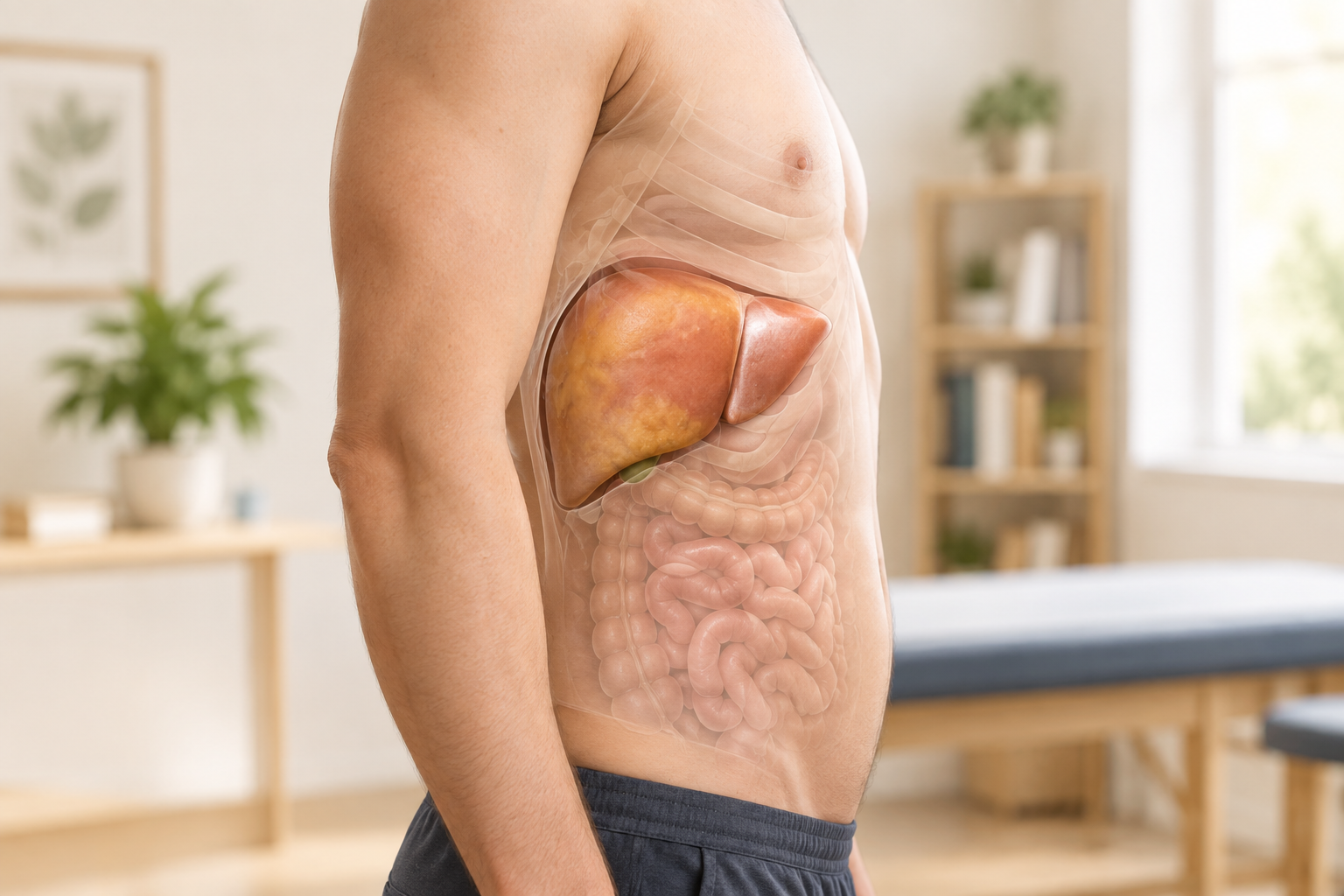
What's going on in the liver?
Understanding the mechanism helps to understand why lifestyle changes work. In metabolic steatosis, everything is often o Insulin resistance. Insulin is the hormone that helps the body manage sugar; when the cells become less sensitive, the organism deranges. This resistance releases more fatty acids to the liver, while excess sugar pushes the liver to make fat itself.
When the liver is overflowing, fat « Toxic » build up and trigger cell stress, inflammation, and then activation of specialized cells that produce fibrosis. Several factors feed this circle: a diet too rich in ultra-processed foods, sugars and sweet drinks, sedentarity, as well as aggravating factors such as genetics, sleep apnea or oxidative stress.
On the alcohol side, the mechanism is different but equally harmful. The body transforms alcohol into a toxic substance, l And these two worlds are not separated: in the same person, alcohol and metabolic problems can reinforce each other, with a sometimes more serious effect than the mere addition of the two risks.
The surprising role of the intestine
A fascinating axis directly connects the intestine to the liver. The liver receives by a large vein called portal vein everything that comes from the intestine. When the intestinal barrier breaks down — alcohol, unbalanced diet or obesity — it becomes more « permeable » and allows substances that trigger inflammation and insulin resistance to pass to the liver.
Even more surprising: our intestinal flora (microbiota) can produce small amounts of alcohol (ethanol) by fermentation, even without drinking a drop. In a healthy person, this alcohol is almost entirely eliminated by the liver and is not a problem. A scientific study showed that in some people, the concentration of ethanol in the portal vein (just before the liver) could be much higher than in the blood of the rest of the body, and increased with the severity of the disease.
This mechanism, however, remains an important amplifier rather than a single cause. In other words, steatosis is not a « hidden alcoholic fermentation », but the ethanol produced by the microbiota can, in some profiles, worsen the mechanisms involved. Nor is it a reason to demonize all carbohydrates or bacteria: it is the overall balance of diet and microbiota that counts.
How is the disease assessed?
Next are simple tests: a blood test (including liver enzymes such as AST, ALT and GGT, blood glucose, fat balance) and imaging. Caution: normal liver enzymes do not exclude advanced disease. In terms of imaging, ultrasound is accessible but not sensitive to mild steatosis, while MRI is the most accurate non-invasive method for measuring liver fat.
The FIB-4: an accessible sorting tool
To assess the risk of fibrosis, a first very useful tool is the score FIB-4, calculated from age and three simple blood parameters (platelets, AST, ALT). It serves as « sort » No definitive diagnosis:
|
FIB-4 Outcome |
Interpretation |
Recommended conduct |
|
Less than 1.3 |
Low probability of advanced fibrosis |
Follow-up and repetition by risk |
|
Between 1.3 and 2.67 |
Intermediate zone |
Supplementary examination (elastography) |
|
Over 2.67 |
High probability |
Expert opinion |
In people over the age of 65, the low threshold is raised to 2.0 to avoid false positives.
Elastography: measuring the « hardness » liver
In case of doubt, elastography (e.g. FibroScan) measures liver rigidity, a good indicator of fibrosis. The more the liver is « hard », the higher the risk of advanced fibrosis. Note: improving liver fat does not automatically prove that fibrosis has declined — These are two different questions.

Treatments and solutions: the way of life first
Weight loss, with proportional effect
In those concerned, weight loss acts according to a logic « dose-dependent » The greater the effort, the greater the benefits:
* More than 5% weight: reduced liver fat.
* 7 to 10% : improved inflammation.
* More than 10% better chance of acting on fibrosis.
Mediterranean food
Physical activity, a powerful ally
The overall target is at least 150 minutes of moderate activity per week (or 75 minutes of intense activity), with less sitting time and at least two muscle building sessions. Encouraging: Physical activity reduces liver fat even without weight losswhile improving insulin sensitivity and cardiovascular health.
Muscle plays a key role here. The sarcopenia (a loss of muscle mass and strength) reduces the body's ability to use sugar, which worsens the metabolic problem. Preserving and developing its muscles is therefore a strategy in its own right, with a protein intake adapted if needed.
Alcohol, sleep and stress
Three other pillars complement the approach:
* Alcohol In alcohol-related forms, durable abstinence is the most prognosis-driven intervention. In case of advanced fibrosis or cirrhosis, abstinence is the safest target. However, a brutal stop that is not framed can be dangerous: it must be supervised.
* Sleep It is useful to check for sleep apnea in overweight people, as lack of nocturnal oxygen increases insulin resistance. Regularity of hours and morning light are simple and effective measures.
* Stress chronic stress complicates sleep, nutrition and motivation. Techniques such as slow breathing, relaxation or heart consistency can help.
Drugs and medical interventions
Attention to false solutions
An essential message: none « detox », drainage or supplement « miracle » does not clean the liver. Some herbal products may even be ineffective, contaminated, interact with medicines, or even damage the liver.
Here's what you need to know about a few products often cited:
* Vitamin E : data exist in some specific cases, but no proven benefit against fibrosis, and no self-medication.
* Omega-3 : useful for certain triglyceride problems, but not as a treatment for MASH.
* Coffee : favourable combinations have been observed, but it does not replace any therapeutic measures.
On microbiota, the 2025 international consensus concluded that there was insufficient evidence to routinely recommend commercial microbiota testing. The strongest lever remains a Mediterranean diet rich in plants and fiber, to be gradually increased.
Warning signs not to be ignored
The Word of the End: Acting on What Matters
The « foie gras » combines two complementary movements: reducing the factors that damage the liver and strengthening health resources. On the one hand, it works on alcohol if necessary, on visceral fat, diabetes, blood pressure and cholesterol. On the other hand, muscle capacity, sleep, food skills, social support and stress management are developed.
Finally, let us keep in mind an important principle: liver steatosis, whether metabolic or alcohol-related, is a multifactorial disease, not a lack of will or moral fault. Understanding the mechanisms, getting assessed with the right tools and gradually acting on his lifestyle are the keys to a healthier liver.
__________________________
This article has a purely informative and educational vocation. Under no circumstances does it replace a medical opinion. If you have any doubts or symptoms, consult a healthcare professional.
@Lonhea – Patented Method

